Pinocchio’s Nose Grows When He Lies
The Adventures of PinocchioPinocchio’s Nose Grows When He Lies turns dishonesty into a visible, increasingly awkward physical consequence. When Pinocchio lies to The Fairy with Azure Hair about the gold coins he has kept, his nose lengthens with each false account; later, an inflated description of his own good character produces the same telltale change. The rule makes concealment difficult and gives the story’s moral contrast a comic bodily form: Pinocchio can invent a story, but he cannot keep his face from contradicting it.
Mechanism and First Demonstration
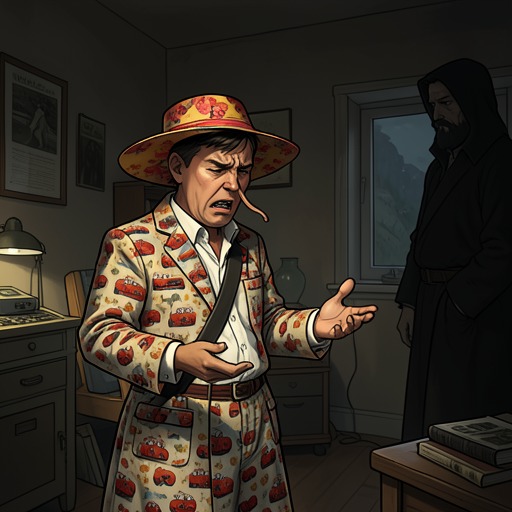
After describing how the Assassins hanged him and threatened to take the coins concealed under his tongue, Pinocchio is asked where the money is. He says he lost it, though he actually has it in his pocket. His nose, already long, grows at least two inches longer. Asked where he lost the coins, he names the nearby wood, and another lie makes it grow a few more inches.
Pinocchio then changes his account again, claiming that he swallowed the coins when he drank medicine. This third falsehood brings the most extreme result: his nose becomes so long that he cannot turn without striking the bed or windowpanes to one side, the walls or door to the other, and nearly The Fairy with Azure Hair’s eyes if he raises it. The sequence connects each new evasion to a further loss of physical freedom. What begins as an attempt to hide a handful of coins ends with a nose that obstructs the liar himself.
The Fairy watches and laughs, then explains that lies can be recognized in different ways: some are short-legged, while others have long noses. Her explanation gives words to what the scene has already staged. Pinocchio’s nose is not merely a sign that he has lied; its growth makes the lie tangible and turns his effort to manage appearances into a practical problem he cannot talk his way out of.
The Body as a Public Verdict
The episode’s comedy depends on the contrast between Pinocchio’s increasingly elaborate explanations and the blunt physical evidence attached to them. His first answer could have concealed the coins if it had been believed; the next answers attempt to supply a plausible location and then a different account of what happened. Instead, each addition makes the hidden truth harder to ignore. The more Pinocchio speaks to protect his secret, the less control he has over the body delivering the confession.
The disproportion is central to the rule’s effect. A lie about missing coins does not remain a private verbal offense: the nose grows until ordinary movement becomes impossible. The bed, windowpanes, walls, and door turn the room into obstacles, while the near blow to The Fairy with Azure Hair’s eyes makes the consequence comic and potentially harmful to someone else. Pinocchio’s deception therefore produces not only embarrassment but a physical predicament that affects the space and person around him.
Claims About Character
The rule recurs when Pinocchio is asked what he thinks of himself. He describes himself as fond of study, obedient, kind to his father, and good to his family. As he makes these flattering claims, he touches his nose and finds it twice its proper length. The growth exposes a different kind of falsehood from the earlier story about the coins: here he is not hiding a possession but presenting an idealized version of his character.
Alarmed, Pinocchio interrupts his own account and admits that the praise is untrue. He instead calls himself wicked, lazy, and disobedient, and acknowledges that he runs away with his playmates rather than going to school. His nose returns to its natural size. In this instance, telling the truth changes the visible condition that the lie created. The rule thus tests not only factual claims about what happened, but Pinocchio’s effort to describe who he is; the honest admission is less flattering, yet it restores his face to its ordinary proportions.
A later exchange shows that the impulse to lie has not simply disappeared. When an old man asks why he is pale, Pinocchio blames a newly painted wall rather than admit that he is ashamed of having been prepared for the frying pan. That moment confirms the persistence of evasive speech, although the passage does not describe a further change in his nose. It therefore contrasts with the earlier scenes, where the physical consequence is explicitly shown, rather than establishing another instance of the rule’s operation.
Narrative and Moral Function
The nose makes a moral lesson legible through action rather than leaving it as an abstract warning. A reader sees the false explanations accumulate, watches the nose grow, and encounters the Fairy’s explanation only after the comic consequence has become unmistakable. The lesson is paired with spectacle: the rule’s physical absurdity entertains, while its immediate result makes the cost of Pinocchio’s dishonesty difficult to miss.
The episodes also preserve a distinction between being caught and choosing to tell the truth. Pinocchio is frightened by the enormous nose, but fear alone does not supply an honest account; at the first encounter, he continues changing his story. In the later self-description, however, he recognizes the lie and corrects it, and the nose returns to normal. Across these scenes, the rule gives false speech a visible consequence while leaving Pinocchio responsible for what he says. His nose can betray him, but the correction comes from his own admission.